
Top 10 Best Stargazing Locations in Bali
Discover the 10 best stargazing spots in Bali, meticulously scouted from over 100 locations. Learn about sky quality, access, and reliability, along with honest downsides to enhance your stargazing experience in Bali's outdoor activities.
Gabrielle Tania
7/24/202612 min read
We Spent Years Getting This Wrong...
So Your One Night Doesn't Have To Be
Most people who come to Bali get one clear night. Maybe two. You don't get a second attempt, and you won't know you picked the wrong spot until you're standing in the dark, two hours from your hotel, looking at a sky that isn't doing anything.
We've had that night more times than we'd like to admit. The one that still stings: two hours of driving to a viewpoint we'd found online, arriving to find a car park full of headlights and generator lighting. We moved ten minutes down an unmarked track out of pure frustration — and the sky opened up. The Milky Way core directly overhead, not a faint smudge but a bright textured band with dust lanes running through it. Nobody in the car said anything for a while.
That's the gap this guide exists to close. Over the past few years we've scouted more than 100 locations across Bali and the neighbouring islands — most at 1 a.m., most of them disappointing, a handful of them the reason we still do this. Four made the cut as places we run sessions from regularly. Everything we learned the slow way is written down below, so you don't have to spend your holiday finding it out.
Here's what makes it worth the effort. Bali sits at roughly 8° south of the equator, which does something very few destinations can: it gives you almost the entire southern sky and a generous slice of the northern one. The Southern Cross, the Magellanic Clouds, Alpha Centauri, and the dense galactic core of the Milky Way — the bright structured part people in Europe and North America never really get to see. Then you turn around, look north, and there's Orion and the Pleiades. Both hemispheres, one night, standing in one place.
The catch is that Bali's dark sky is not where most visitors sleep. The south is bright, the good ground is unlit and usually unmarked, and the difference between a viewpoint and a good viewpoint is about fifteen minutes of local knowledge that isn't written down anywhere.
Until now. This guide covers ten locations. It explains exactly how we scored them, and it gives you the honest downside of every single one — including our own favourites, and including the one we rate 2 out of 5 for sky quality and still recommend to the right people.
Read it, pick your night, and go. If you'd rather we just took you, that's what we're for.
How We Score a Stargazing Location
Most "best stargazing spots" lists rank places by how nice the photos look. We score on five things, because a location can be beautiful and still be a wasted night.
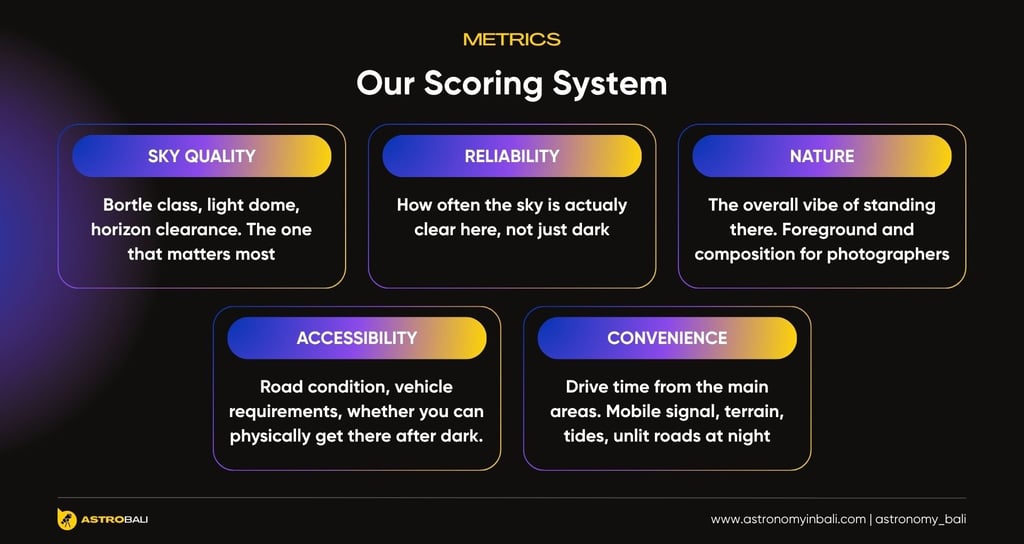
Reliability
This is the metric almost nobody talks about—because it's the hardest one to analyse. A location may look spectacular in photos, but if cloud cover is unpredictable or weather patterns consistently interrupt the view, it's not a location we recommend. The reality is that night sky conditions are dynamic, and knowing when a place works is often more valuable than simply knowing where it is.
That insight comes from experience. Hundreds of scouting trips across Bali have allowed us to understand the subtle weather patterns, seasonal shifts, and microclimates that determine whether a night is likely to deliver an exceptional stargazing experience.
★ Signature Locations
Our ★ Signature Locations represent the four exclusive sites where we host our experiences. These locations consistently scored highest in the two factors that cannot be created or improved: sky quality and reliability. Beyond exceptional viewing conditions, we've also secured access to private locations that are not publicly available, allowing our guests to experience Bali's night sky away from crowds, artificial light, and distractions.
The Rankings
Every location we visited was scored across five key criteria. After scouting more than 100 locations across Bali, only 10 made it into our guide—and just 4 consistently met our standards to become our Signature Locations.
1. Mount Batur & Kintamani — best overall
Sky 5 · Reliability 4 · Nature 5 · Access 5 · Convenience 4 — Total 23
Bortle 3–4 · ~2 hrs from Canggu, ~1.5 hrs from Ubud · 1,200–1,700 m
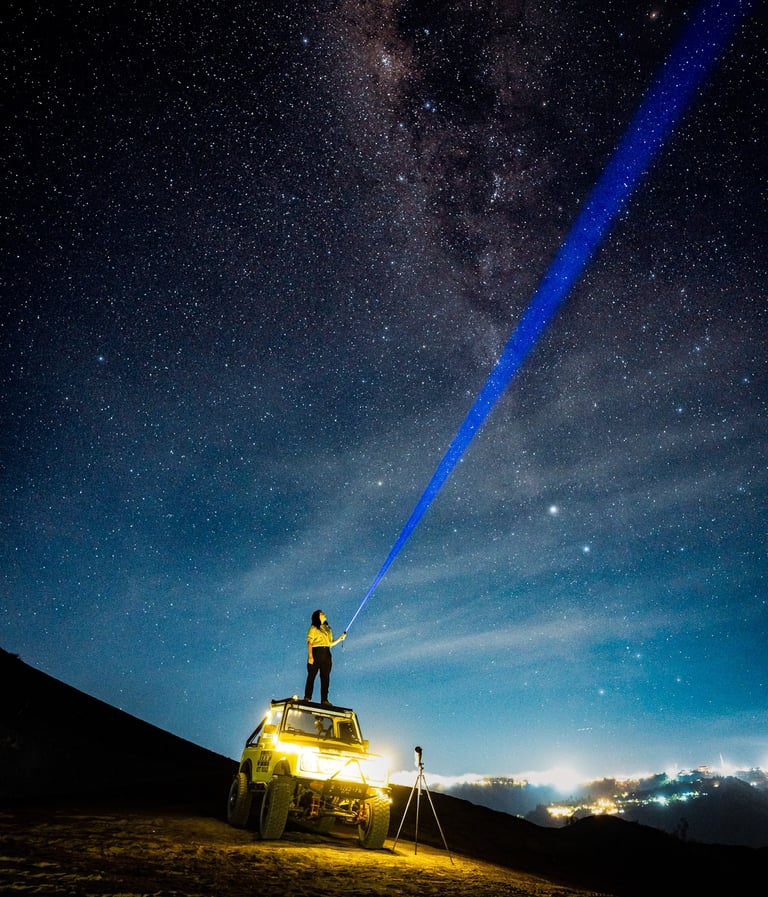
Kintamani is the best stargazing region in Bali and it isn't close. Elevation puts you above the humid haze layer that softens the sky everywhere at sea level, and the caldera's northern aspect faces away from Denpasar's light dome. On a clear moonless night the Milky Way core rises out of the volcano ridge with visible dust lanes — no camera needed.
Night temperatures drop to 12–16°C, which sounds unpleasant and is exactly the point: cold dry air is steady air, and steady air is what makes planets sharp through a telescope.
This is also the most versatile site on the island. It works as a Jeep adventure, it works for sunset, it works for sunrise, and which we recommend depends on the moon calendar for your dates. The road up is sealed and in good condition the whole way, which is why it scores full marks on access despite the distance — you don't need a 4WD to reach the region, only to reach the better ground within it.
The honest downside: the well-known caldera viewpoints fill from around 2 a.m. with trekking convoys, headlights and generator lighting. Arriving at the popular spot expecting solitude is the most common mistake visitors make here. The caldera also generates its own cloud on humid nights, which is why reliability is 4 and not 5.
How we handle it: our Kintamani sessions run from unmarked locations away from the trekking routes, chosen for horizon clearance and zero passing headlights. Same sky, none of the crowd.
2. Gianyar — Saba Beach — best near Ubud
Sky 4 · Reliability 4 · Nature 4 · Access 5 · Convenience 5 — Total 22
Bortle 4 ·~1 hr from Ubud
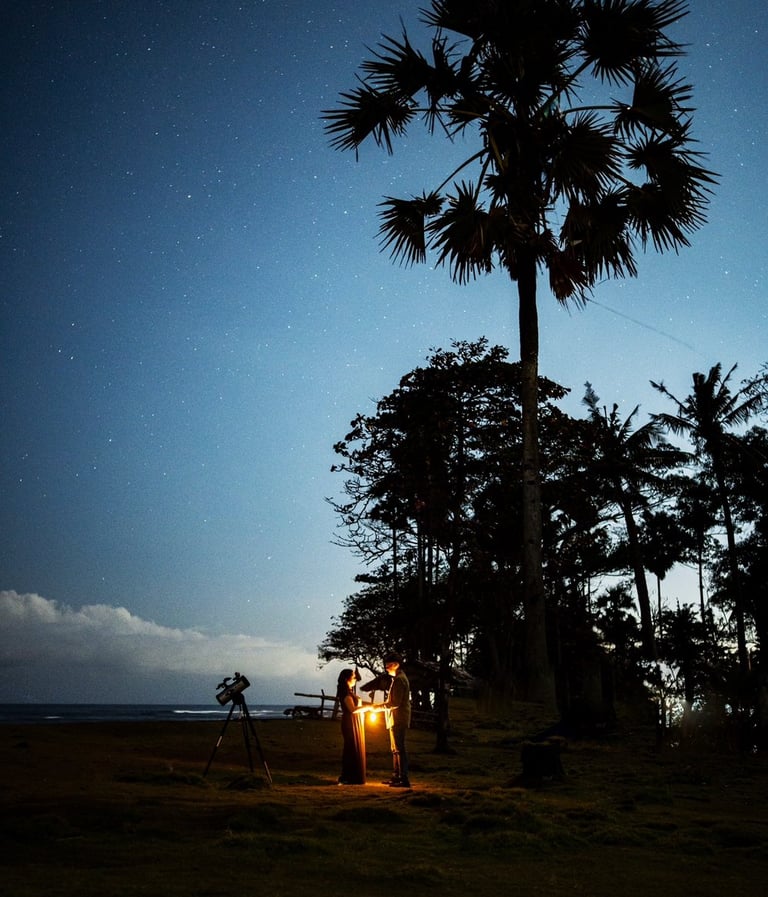
Saba is the most balanced site on this list and the one most visitors have never heard of. It's an unusual landscape for Bali — open savanna running down to black sand beach — which gives you something rare here: a genuinely clear horizon in several directions, with no ridgeline or palm canopy cutting off the low sky.
On good nights we pick up a faint Milky Way band. Not the structured detail you get at Kintamani, but visible, and remarkable for somewhere an hour from Ubud on sealed road the whole way.
We host regular sessions here. For anyone based in Ubud, this is the best sky-per-hour-of-driving on the island.
The honest downside: it's a coastal site, so humidity and sea haze soften the sky compared to elevation. Milky Way visibility here is conditional, not guaranteed — some nights it's there, some nights it isn't. Manage your expectations and you'll rarely be disappointed.
3. Nusa Dua & the peninsula — best for zero-effort stargazing
Sky 4 · Reliability 4 · Nature 3.5 · Access 5 · Convenience 5 — Total 21.5 ~0 min if you're staying there, highway access from Seminyak
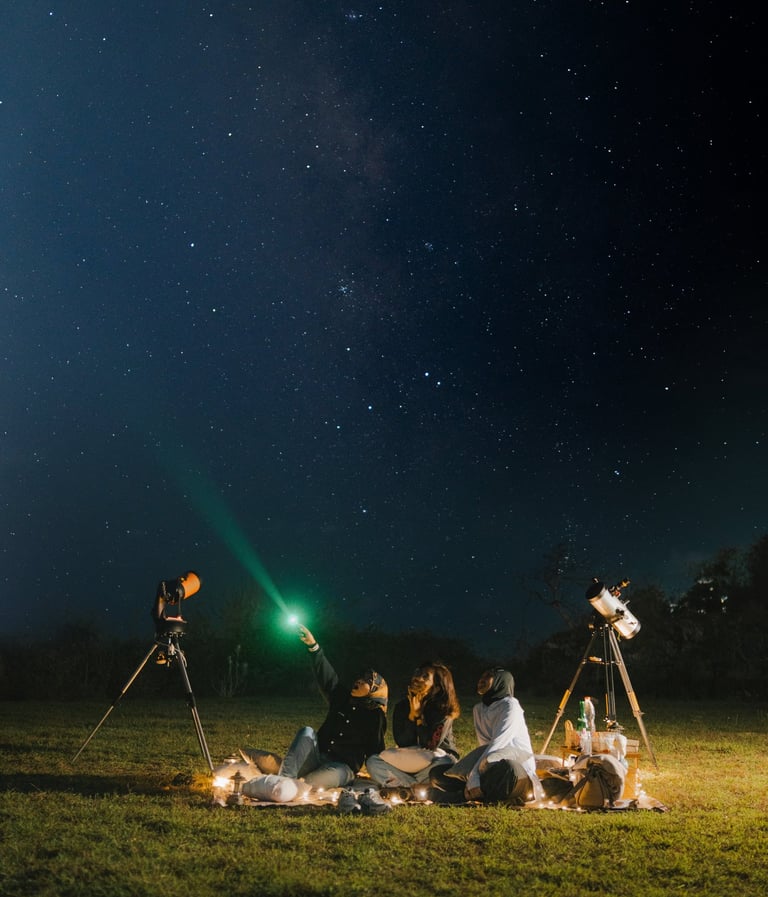
Nusa Dua is the most accessible real stargazing on the island. Highway the whole way, open sightlines over the water, and a dark southern horizon over open ocean — which means the Southern Cross, Alpha Centauri and Canopus are all comfortably visible. The Moon, Saturn's rings and Jupiter's moons look excellent here regardless of surrounding light, because bright objects don't care about sky glow.
If you have one night, a young family, limited mobility, or no appetite for a mountain drive, this is the right choice, and we run sessions here for exactly those reasons.
The honest downside: you're closer to the southern light dome than anywhere else on this list, so the faintest deep-sky detail is compromised. It scores lowest on nature for a reason — it's a resort area, not wilderness, and the atmosphere reflects that. You're trading some sky and all of the remoteness for the ability to walk back to your room in ten minutes.
How we handle it: there's one spot on the peninsula with a meaningfully darker southern aspect than the public beachfront. We keep it for private sessions and don't publish it, because its value depends entirely on it staying empty.
4. Tabanan & Kedungu — best for Canggu and Seminyak
Sky 4 · Reliability 4 · Nature 4 · Access 5 · Convenience 4 — Total 21
Bortle 4 · ~30–60 min from Canggu
The Tabanan interior and the coast around Kedungu make up the most underrated dark sky area in southern Bali. Light pollution falls off fast once you're fifteen minutes off the main coastal road, and it's close enough that you're not committing your entire evening to driving — the shortest drive of any site on this list.
We hold a private location in this area, chosen because the surrounding land stays unlit and there's no through traffic.
The honest downside: proximity is not the same as ease. Many of the good clearings sit on private land or down unlit single-lane roads that are genuinely hard to navigate after dark, and there are no facilities out there — no lighting, no toilets, nowhere to wait if the weather turns. That's why it scores 4 on convenience rather than 5 despite being the closest option to Canggu. This is not a place you find by dropping a pin, and wandering into someone's rice field at midnight is a poor way to spend an evening.
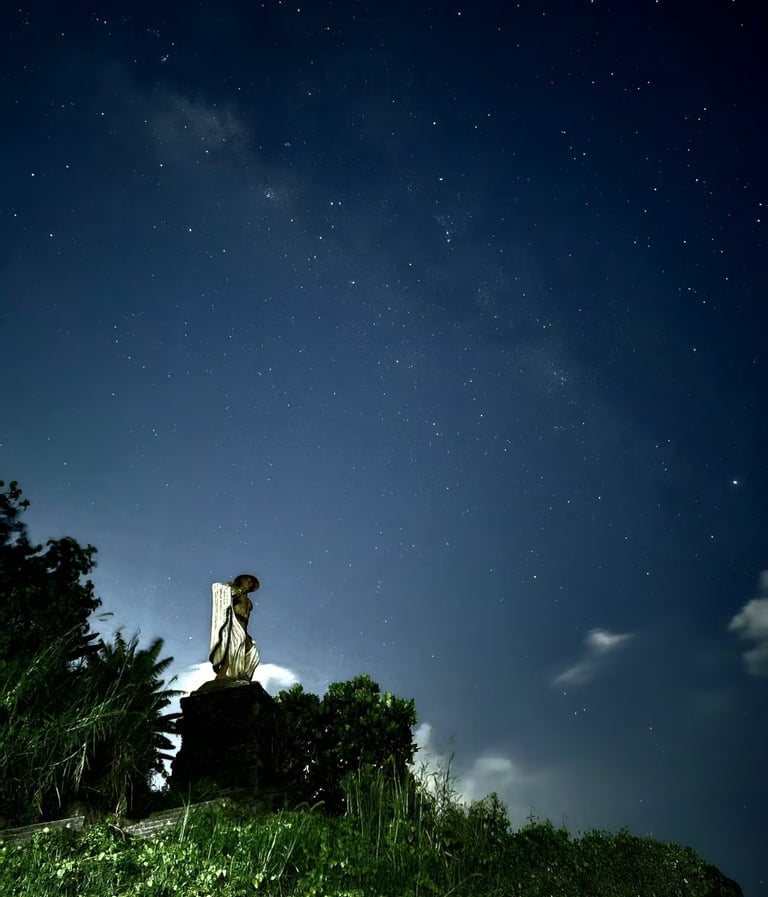
5. North Bali & Buleleng — excellent sky, difficult logistics
Sky 5 · Reliability 3.5 · Nature 5 · Access 3 · Convenience 2.5 — Total 19 Bortle 3 · ~3.5–4 hrs from the south
Some of the darkest usable sky in Bali. The central mountain range physically blocks the entire southern light dome, and the coastal towns up here are small and dim. Sky quality matches Kintamani, and the setting — black sand, quiet fishing villages, mountains behind you — is genuinely beautiful.
The honest downside: the mountain crossing is winding, slow and unpleasant at night, and it's the lowest convenience score on this list. Buleleng works if you're already staying north or building it into a multi-day trip. As a dedicated night trip from Canggu, the arithmetic doesn't work.
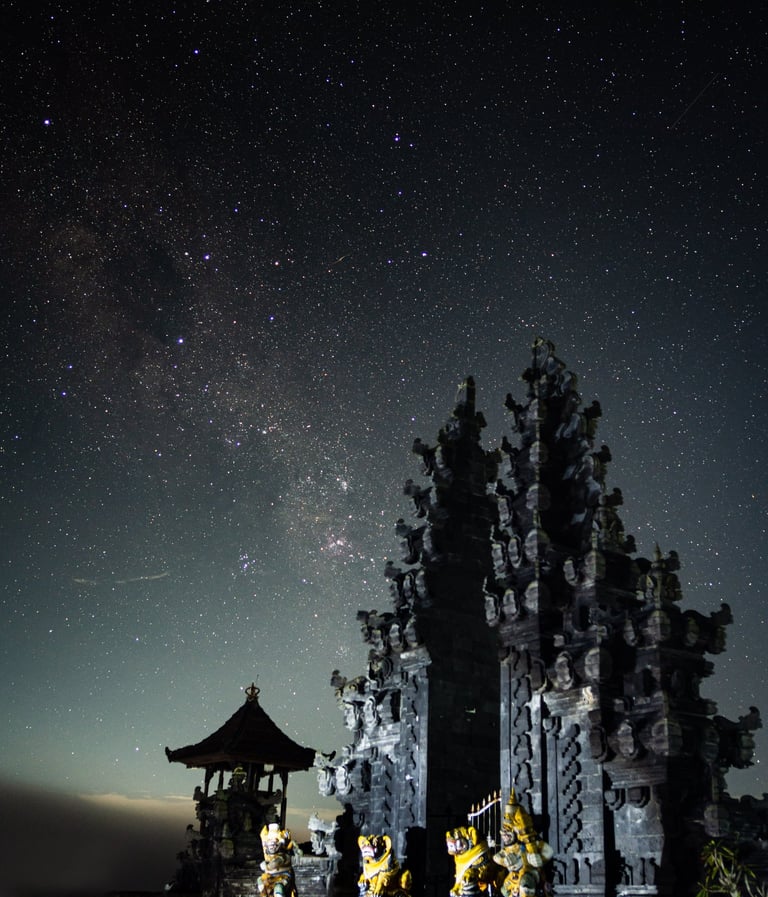
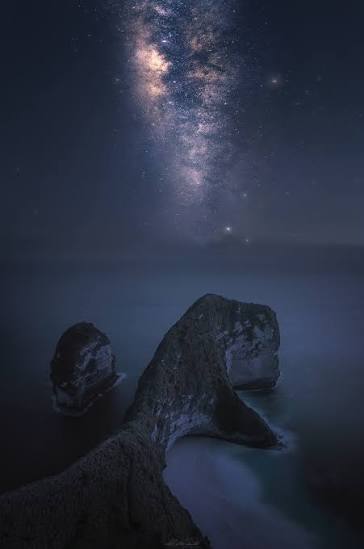
6. Nusa Penida — darkest sky in remote island
Sky 5 · Reliability 3 · Nature 5 · Access 3 · Convenience 3 — Total 19 Bortle 2–3 · 45-min fast boat from Sanur, plus island transport
Nusa Penida has the darkest sky in this guide. Rural island, minimal grid lighting, separated from Bali's light dome by open water. The interior and east coast are close to genuinely pristine. If you want to see the Milky Way the way it looked before electric light, this is where you go.
Our personal favourite here is Atuh Beach in the pre-dawn hours. You come down to the cove while it's still fully dark, with the sea stacks silhouetted against the stars and the whole eastern sky ahead of you, and you stay until sunrise comes up over the water. It's the best hour on the island and almost nobody is there for it.
The honest downside: it's an overnight commitment, not an evening. Last boats back leave in the afternoon, island roads are rough and poorly lit, and driving Penida's interior after dark without local familiarity is a bad idea. Plan to sleep there. Reliability also runs lower than the mainland east coast — the island catches more passing cloud than its latitude suggests.
And a specific warning about Atuh: the monkeys around the clifftop and the descent path are bold and habituated to people. They will go through an unattended bag, and they can get aggressive around food. Keep snacks sealed and out of sight, don't leave gear on the ground while you're setting up a shot, and don't try to shoo one off your equipment. It's manageable if you're expecting it and genuinely unpleasant if you're not — which, along with the steep stair descent in the dark, is why Penida scores low on convenience despite having the best sky here.
7. Sidemen & Candidasa — best for an overnight stay
Sky 4.5 · Reliability 3.5 · Nature 4 · Access 3 · Convenience 4 — Total 19 Bortle 3–4 · ~2 hrs from Ubud
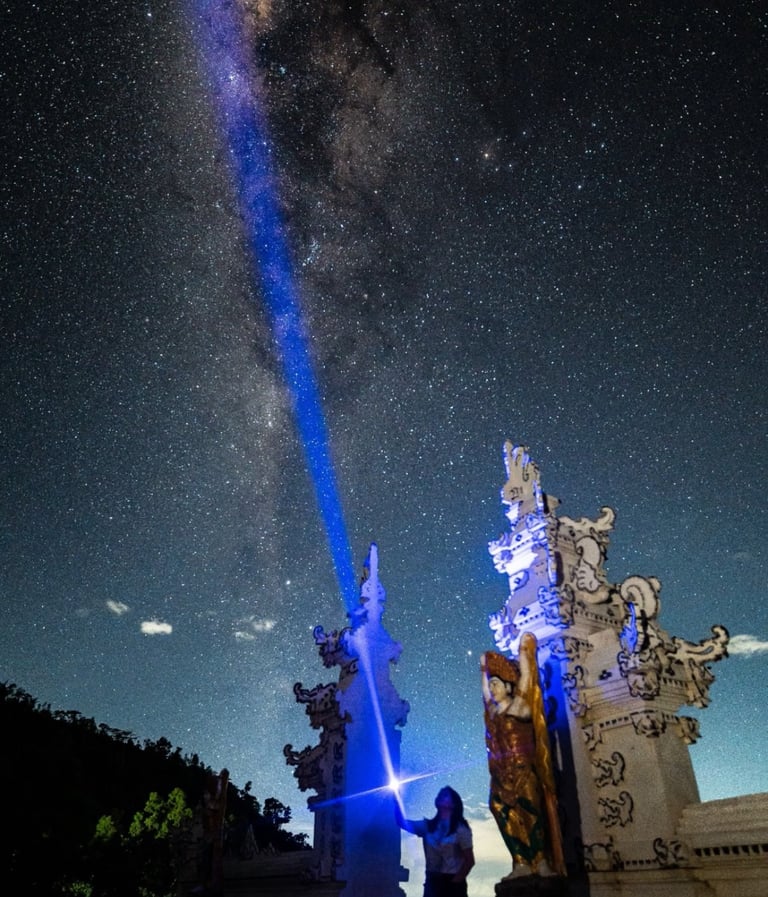
Two connected areas worth treating as one trip. Sidemen sits inland in the river valley below Agung — terraced, quiet, and dark once the village settles. Candidasa gives you the coast, and Bukit Asah nearby is a grassy clifftop above the sea that's one of the most photogenic places in Bali to shoot a night sky. The eastern aspect points away from every major light source on the island.
This is the best area on the list for an actual overnight rather than an evening, and there's enough accommodation to make that easy — hence a convenience score well above the other remote sites.
The honest downside, and take this one seriously: mobile reception at Bukit Asah and along parts of that coast is very poor to non-existent. If your transport leaves, you have no way to call anyone. Do not go without confirmed transport that stays with you, and tell someone your plan before you set out. The clifftop access track also degrades badly after rain.
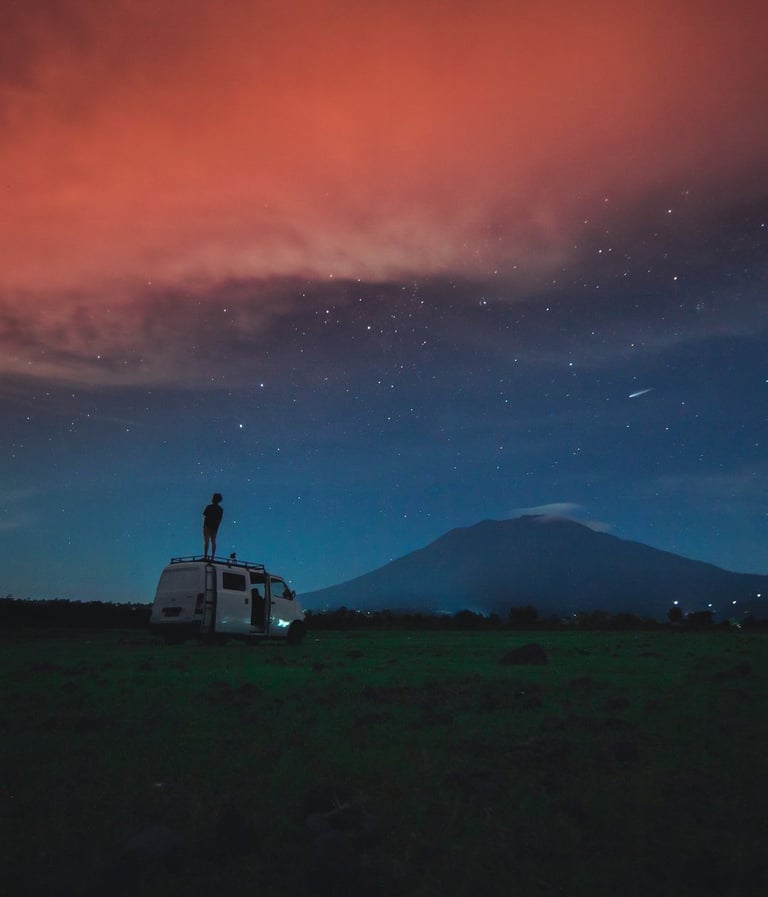
8. Northeast Bali — Amed & Tianyar — best for meteor showers
Sky 4.5 · Reliability 4 · Nature 4 · Access 3 · Convenience 3 — Total 18.5 Bortle 3 · ~2.5–3 hrs from the south
The northeast coast is the driest corner of Bali, and that changes the calculation entirely. It sits in the rain shadow, with measurably fewer cloudy nights than the south or the central highlands — and the gap is widest exactly when you need it. Tianyar in particular has wide open black sand flats with an uninterrupted northern and eastern horizon.
That makes this the right call for meteor showers. The Geminids in December and the Perseids in August are events with fixed dates you cannot move, and if your one night clouds over, the shower is gone for a year. The northeast gives you the best odds of a clear sky on a date you don't control. Mount Agung sits behind you as a foreground, and the Lombok Strait gives you a dark eastern horizon.
The honest downside: it's far, and the last stretch of coast road is slow after dark. This is a planned trip around a specific date, not a spontaneous evening.
9. Nusa Ceningan & Lembongan
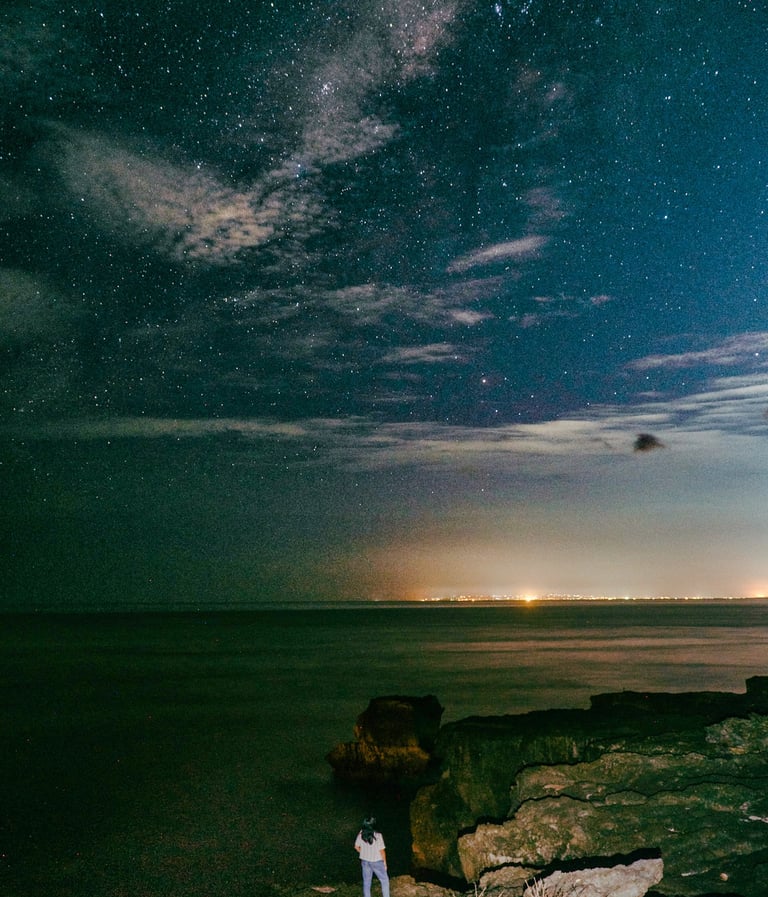
Sky 5 · Reliability 4 · Nature 4 · Access 2 · Convenience 3 — Total 18 Bortle 3 · Boat to Lembongan, then the yellow bridge
Darker than mainland Bali and far easier to reach than Penida's interior. What sets these islands apart is the coastline: small, mostly unnamed coves with black volcanic rock, sea stacks and tidal pools that photograph like a completely different latitude — closer to Iceland than to tropical Indonesia. Put the Milky Way core above that foreground and you get an image nobody will guess was taken in Bali.
The honest downside: lowest access score on the list. It's boat-dependent, the coves are tide-dependent, and several are genuinely dangerous or unreachable at high water. The rock is sharp and slippery. Timing matters more here than anywhere else in this guide, and getting it wrong has consequences beyond a disappointing sky.
10. Uluwatu & the Bukit — losing ground
Sky 4 · Reliability 3 · Nature 3 · Access 4 · Convenience 3.5 — Total 17.5 Bortle 4–5 · ~1 hr from Seminyak
Uluwatu used to rank higher, and we'll be straight about why it doesn't now: villa development has taken most of the good cliff and beach access. Sites that worked two years ago are built on, gated or lit. What remains is either developed or genuinely remote, with very little in between — which is also why nature scores only 3 despite the setting being spectacular on paper.
The dark pockets that survive are properly dark, and the south-facing clifftops still give you an uninterrupted ocean horizon, where the Magellanic Clouds and the deep southern Milky Way clear the horizon in a way they don't inland.
The honest downside: several of the remaining good beaches can't be reached by car at all, and the ones that can involve unlit tracks and clifftop edges without railings. Getting stranded out here is a real possibility, not a hypothetical. This isn't a site we'd send anyone to unguided.
Ready to experience Bali's night sky?
Finding a dark location is only the beginning. Choosing the right location, on the right night, under the right conditions is what transforms stargazing from simply looking up into something unforgettable.
After scouting more than 100 locations across Bali, we selected just four that consistently deliver exceptional night skies. Every session is planned around the weather, moon phase, seasonal conditions, and accessibility—because the best experience isn't always at the same place every night.
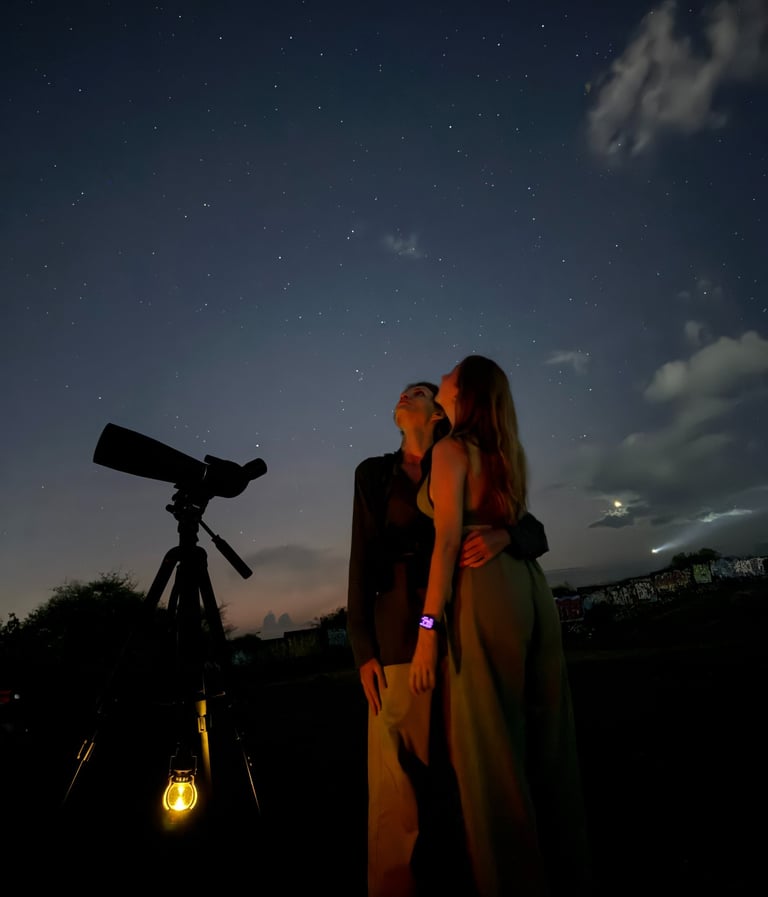
Join us for a private stargazing experience at one of our Signature Locations, complete with premium telescopes, expert guidance, and exclusive access to places we've spent years testing and refining.
